

If you’ve ever spoken the Nicene Creed in church, you were joining a confession that Christians have proclaimed for more than 1,600 years. But this creed wasn’t created as a tradition or mere formality—it was written in a moment of crisis, when the church needed clarity about the truth of Jesus.
In the early 300s, a priest named Arius from Alexandria began teaching that Jesus was not truly God but the first and greatest being God had created. His message spread quickly, but it carried devastating implications. If Jesus were not eternal, He could not fully reveal God. If He were not fully divine, He could not save us.
The debate grew so intense that Emperor Constantine convened church leaders in 325 AD in Nicaea. Over 300 bishops attended, many scarred by years of persecution. They prayed, debated, and studied Scripture to answer a crucial question: Is Jesus fully God, or something less?
Their answer came in the form of a creed. Against Arius, they confessed that Jesus Christ is “begotten, not made,” of one essence with the Father. The creed declared Him eternal, equal, and inseparable from the Father, and it affirmed His incarnation, death, resurrection, and future return.
In 381, the church gathered again at Constantinople to reaffirm and expand the creed, especially to emphasize that the Holy Spirit is also fully God, the Lord and giver of life. This is the version most Christians still recite today.
The Nicene Creed is more than history. It anchors our faith in the eternal Son of God who became human, died for our sins, and rose again. When we speak these words, we join voices with believers across the centuries, declaring with confidence that Jesus Christ is Lord—true God from true God, the Savior of the world.
“We believe in one Lord, Jesus Christ,
the only Son of God,
eternally begotten of the Father,
God from God, Light from Light,
true God from true God,
begotten, not made,
of one Being with the Father.
Through Him all things were made.
For us and for our salvation
He came down from heaven;
by the power of the Holy Spirit
He became incarnate from the Virgin Mary,
and was made man…” – Nicene Creed (381 AD the Niceno-Constantinopolitan Creed)
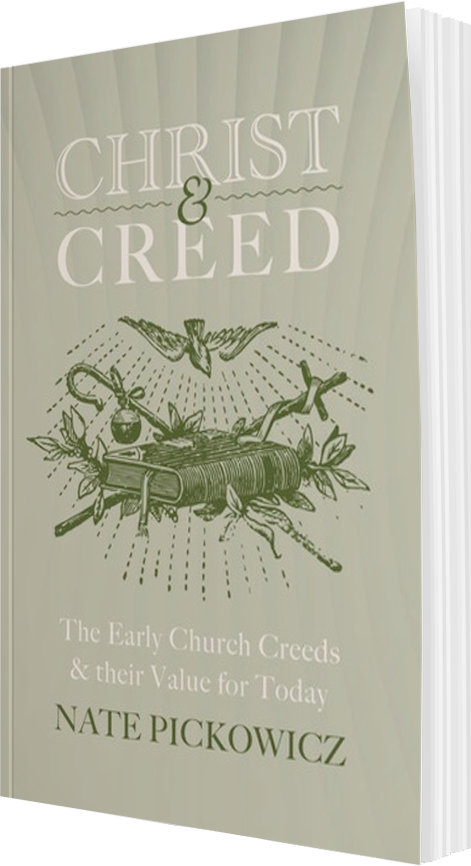
Christ and Creed
Struggling to articulate the core truths of the Christian faith? The early Church creeds—crafted in times of challenge and controversy—have served for centuries as clear, faithful summaries of biblical doctrine. In Christ and Creed, Nate Pickowicz explores four historical statements: the Apostles’ Creed, the Nicene Creed, the Definition of Chalcedon, and the Athanasian Creed. With clarity and conviction, he unpacks their historical context and theological significance—showing how these timeless truths can strengthen our faith, deepen our unity, and guard the Church against heresy today.