

What happens when artificial intelligence meets the ministry of the Word?
For a busy pastor, the appeal is easy to understand. Unexpected needs within his congregation fill the week. By Saturday afternoon, he is exhausted, and his sermon remains unwritten. A few prompts into an AI tool could produce a polished, seemingly sound message in minutes. Add a personal illustration or two and listeners might never know the difference.
But should efficiency be our primary concern? What might we lose when technology takes the place of the human preparation, prayer, and dependence that Gospel ministry requires?
These questions reach beyond sermon writing. AI-generated voices and videos can imitate real people with remarkable accuracy, raising concerns about authenticity and trust in Christian media.
As I consider these developments, three biblical convictions shape how I believe we should approach generative AI in ministry:
- Human beings are made in the image of God. That truth should shape how we understand our role in proclaiming His Word.
- Our infinite, eternal God accomplished our salvation by becoming truly human. Jesus took on physical weakness, the need for sleep, and the limitations of human life. Philippians 2:7 tells us that He “emptied Himself, by taking the form of a servant, being born in the likeness of men” (ESV).
- Within those limitations, Jesus preached the Good News of the Kingdom and accomplished our salvation. He then commissioned His followers:
“As the Father has sent me, even so I am sending you.”
—John 20:21, ESV
Being human is a privilege and honor. God has entrusted His people with the work of bearing witness to Christ and our humanity is part of that calling.
When we consider using AI to produce sermons or recreate a speaker’s voice and likeness, we should ask whether we are supporting that human witness or replacing it. Are we using a tool to assist the work God has given us or handing that work over to technology?
Jesus did not send His disciples into ministry equipped only with information and communication skills. He promised them the Holy Spirit. After His resurrection, He instructed them to wait in Jerusalem for the Father’s promise:
“For John baptized with water, but you will be baptized with the Holy Spirit not many days from now.”
—Acts 1:5, ESV
At Pentecost, the Holy Spirit illuminated the Scriptures for Peter and filled him with boldness to preach. Through the Spirit’s work, people heard the Gospel in their own languages.
The power behind that moment came from God. The Spirit gave understanding, conviction, and the ability to communicate truth across language barriers.
AI tools can generate explanations of Scripture, imitate persuasive delivery, and translate words into other languages. Yet those capabilities should lead us to examine where we place our confidence.
Are we depending on the Holy Spirit to work through us? Are we giving ourselves to prayer, Scripture, and the preparation ministry requires? Or are we allowing the convenience of technology to displace that dependence?
A polished message cannot substitute for the Spirit’s work in the person proclaiming it.The Apostle Paul understood that faithfulness was central to his calling:
“This is how one should regard us, as servants of Christ and stewards of the mysteries of God. Moreover, it is required of stewards that they be found faithful.”
—1 Corinthians 4:1–2, ESV
Christian ministry must be guided by more than speed, reach, or measurable results. The methods we use matter to the Lord.Our first question should be, “How can we serve Christ as faithfully as possible?”
Paul gives us a picture of that faithfulness in his second letter to the Corinthians:
“We do not use deception, nor do we distort the word of God. On the contrary, by setting forth the truth plainly we commend ourselves to everyone’s conscience in the sight of God.”
—2 Corinthians 4:2, NIV
This has direct implications for synthetic audio and video. When generated content is presented in a way that leads people to believe they are hearing or watching an actual human recording, it raises serious questions about truthfulness.
We must consider both the message we communicate and the impression our methods create. Does the audience understand what they are receiving? Does our use of technology reflect the integrity of the Gospel we proclaim?
Faithful ministry requires us to speak truth and practice truthfulness.These convictions do not mean every use of AI is inappropriate. Checking grammar, assisting with routine tasks, and other practical applications can be useful. I believe there will also be redemptive applications of AI that the Lord uses to advance His kingdom.
But usefulness alone does not settle every question. Each application deserves careful consideration, especially when it touches the proclamation of Scripture or the trust people place in a ministry.
At Haven Ministries, our conviction is that Jesus has entrusted the Gospel to human image bearers. He calls us to serve within the limitations He has given us, relying on the Holy Spirit for power and pursuing faithfulness in both our message and our methods.
As digital content becomes harder to distinguish from authentic human communication, the need for wisdom will only grow. Our witness must reflect truthfulness, integrity, and dependence on Christ.
The work belongs to Him. So do the results. Our responsibility is to serve faithfully, remembering that everything we do is ultimately all about Jesus.
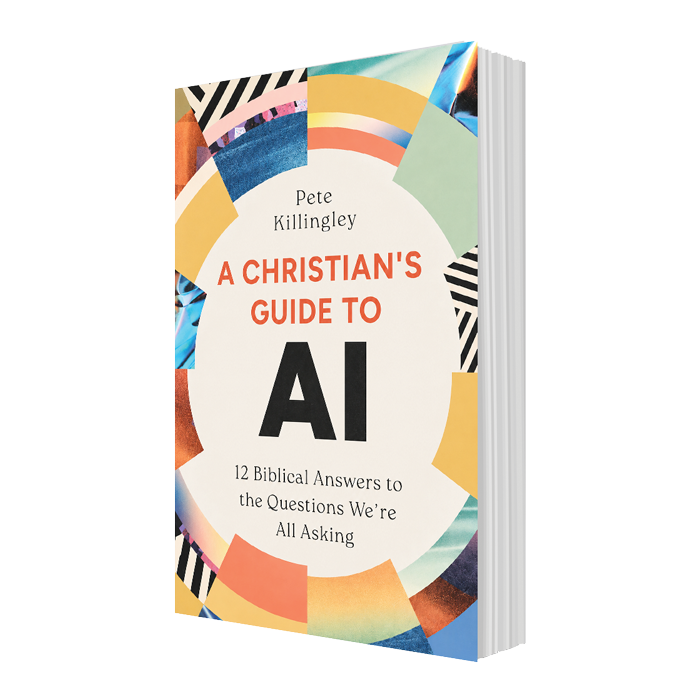
A Christian’s Guide to AI
AI is rapidly becoming part of everyday life, but how should Christians think about it biblically? In A Christian’s Guide to AI, Pete Killingley explores twelve important questions, including what AI is, how humans–who are made in God’s image–differ from AI, whether AI can tell the truth, and how Christians should use it especially when studying the Bible. With clarity and humility, Killingley offers biblical wisdom for navigating this emerging technology.